Friday, August 3, 2012

Politicians....Organized Criminals ??? (part 3)

Preface 
This is the third and last post of the trilogy, where I have tried to explore the similarity between politics and organized crime in the country. This post goes into the depth of political rot in contemporary times and also explores the few silver linings in these dark clouds.

        With the end of Congress Hegemony in Indian Politics in 1989, it was now the era of coalition and vote bank politics. By this time, there was widespread public disinterest in politics. The middle and upper class were completely alienated from the electoral process. The elections were wide open, with extremely low winning margins and several close candidates for each seat. It essentially meant that to be 'first past the post' in any elections, you don't require support cutting across all communities, like in earlier times. Hence, instead of a 'unity in diversity' campaigns for the entire constituency, the complete electoral emphasis was now on specific targeted audiences, based on caste, religion, ethnicity, region etc. The old imperialist technique of 'Divide and Rule' was perfected by the modern Indian Politicians. These politics led the Indian society in the vicious cycle of mutual hate and self-destruction which continues unabated even today.


Protest Against Mandal Commission
        Ticket distribution on the basis of caste has been going on since the late 1950s.  However regressive caste politics reached new heights with the development of competitive reservation system, for vote bank purposes. Every caste/community started proving themselves backward and demanding reservations, added and abetted by opportunist political leaders. Instead of expanding the overall pie, all efforts went in securing a smaller separate slice for ever increasing sub-divisions. As expected it led to a development of creamy layer in every historically oppressed section of Indian society. The creamy layer kept reaping almost the entire benefit of reservations while the remainder remained untouched as they couldn't even cross the minimum qualifying threshold.


Ram Rath Yatra by L.K Adavani
        The Hindu fundamentalist groups had long been sidelined by secular charismatic leaders such as Gandhi and Nehru. But the continuous vote-bank minority appeasement policies led to dissatisfaction in the majority. On the highly emotional and religious demand of creation of 'Ram Janyabhoomi Temple', the Hindu fundamental groups revived themselves. It finally resulted in BJP forming the first stable non-Congress government in the country. As expected, acquisition of power in the center led to a more moderate and secular approach being adopted. India finally found the long required and very essential (right-winged) political alternative to Congress. However it came at a huge cost on the society. The demolition of Babri Masjid led to several religious riots. The Gujrat riots of 2002, was the second major government-supported riot in the country after the Anti-Sikh riots of 1984.  

Laloo Yadav
        Party sponsored criminals, during elections, had been a very common thing, right from the late 1960's. Later booth capturing, intimidation and sporadic violence during elections, became the norm of the day. But now hard-core criminals started coming into politics. With their muscle and money power, they were able to gather enough critical votes to be the 'first past the post' and hence they were welcomed with open hands in all parties. The thin line between organized crime and politics was blurring very fast. One of the worst sufferers was the state of Bihar. For more than two decades, the state was very similar to a mafia-ruled place. There were even parallel caste armies and proxy civil wars in the state. Things were not much better in the rest of the country either. In eastern India and especially in tribal areas, organized exploitation by the state and police machinery increasingly drove people to violence and Naxalism.


Political Choice
        All the mainstream parties more or less lost their separate identities. Party ideology became a poor jokePeople frequently swapped sides with perfect ease between rival parties. Horse trading and power struggle became far too blatant and unapologetic. In a supposedly spiritual country of ours, public morality and even basic ethics were thrown out of the window. Another interesting pattern is the change in the personal relationships between ardent political rivals. It had progressed from once ideological differences to personal differences, to now pure shadow-boxing. On a personal level, everyone in politics helped each other. They even bailed out their opponents at critical times, ensuring that rarely anyone ever got convicted in courts. For all effective purposes, the complete political class was above the law. Although outwardly, the politics appeared to be more dynamic, with no party ever being sure of returning back to power; actually, the system became very stagnant, with no real change being brought about, through any elections.

P V Narsimha Rao
        By the early 90's, Indian economic was in tatters. There was a minority government at the center headed by Narasimha Rao, who had mastered the act of staying in power, by hook or by crook. There was not even a single party then, that had economic liberalization in its agenda. Yet the circumstances forced India to liberalize its economy. Great path-breaking reforms that would have never passed had there been proper discussion or debate on it, in the parliament, were readily passed as  everyone was just busy trying to avoid a second election and get the maximum out of the costly election that they had somehow won.


People's Committee Against Police Atrocities
        Apart from having a very positive impact on the economy, the economic reforms completely changed the scale and scope of corruption, black money and politics in India. The pace of economic reforms and liberalization slackened as soon as the Indian economy stabilized. Certain key sectors were never reformed, and the bottleneck in those critical areas now yielded much higher returns for the bureaucracy and politicians, from the increasingly rich business class. The country moved from 'ineffective socialism' to 'effective crony capitalism'. This crony capitalism led to very harmful effects on the environment and much greater exploitation of the extremely poor (especially tribal) class. As a reaction to it, counter-productive communism and Naxalism spread explosively, to cover approximately one-third the total districts of the country.

        As the scale of corruption scandals grew, so did the task of covering it. Rajiv Gandhi made a mess of covering up the Bofors scam and hence paid dearly. Learning from that, the politicians soon realized the need to bring every investigative agency, especially CBI, under their water-tight control. Very soon they were masters of the game and even the creation of CVC by Supreme Court through the famous 'Vineet Narain case' helped little. CBI soon became one of the most effective tool, in the hands of the government to blackmail its coalition partners and others in the opposition.

Election Commissioner, T N Seshan
        After the demise of Indira Gandhi, the non-political, independent institutions of the country slowly strengthened themselves. In 70's and 80's a number of elections were rigged. Money and muscle power had become predominant in Indian elections, slowly turning India into a banana republic.  One man, Election Commissioner, T.N. Seshan changed it all. He utilized the power and autonomy of the Election Commission, under the constitution, to free the office from all political pressures. His legacy ensured that elections became freer and fairer over the years.


Vinod Rai, The Controler and Auditor
General (CAG) of Ind
        After the Emergency, no government could ever dare to put binding restrictions on the media. With the emergence of TV and the subsequent popularity of the media, it became a very powerful fourth pillar of democracy. The media has never been completely free from political pressures. However the fact that its competitive popularity in most cases, rests on taking an anti-political and anti-establishment stance, has led it towards constant scrutiny and criticism of the politics. Similarly, as the executive kept losing popular support and people power, the judiciary filled in the gap through increasing judicial activism. A lot of important decision were taken and monitored in courts rather than in executive bodies. Historically, the CAG's audit reports were routinely thrown into the dustbins by the politicians. Lately, under Mr. Vinod Rai, the CAG has successfully managed to name and shame politicians. Thus India has, over time, developed and nurtured all the necessary elements of a fully working democracy.

        The advent of modern technology, the internet, social media, the spread of education, the growth of urban middle class and increase in prosperity due to economic reforms has strengthened the civil society of India. IT revolution, growing demand for e-governance and greater public scrutiny through acts like RTI has dented the political power slightly. Even though disturbing similarities do exist between current politicians and organized criminals, the experience of other countries, who have gone through a similar path, suggest a far rosier future for India. India is too diverse a country to make any sweeping statement and hence it remains a matter of speculation whether Indian politics has reached its nadir or not.

Saturday, June 2, 2012

Politicians....Organized Criminals ??? (part 2)

Indira Gandhi
        In the previous post, I went over the initial era or the golden era of Indian politics, from Jawaharlal Nehru to Lal Bahadur Shastri. Till this time the rot was only at the lower levels, while the Gandhian aura still persisted in the higher echelons of power. Politicians were still highly respected and revered in the society and great debates used to happen in the parliament. All this was about to changed very rapidly.
       
        Indira Gandhi had been the president of the Congress in 1959, but that was not something liked by Nehru. He never gave her a cabinet berth and he was frequently embarrassed by her ruthlessness and disregard for parliamentary traditions. Only due to growing nepotism in the party, Lal Bahadur Shastri gave her an unimportant portfolio in his ministry. However defeating Morarji Desai in the party election, she became the next Prime Minister of India. 
     
        Indra Gandhi stood for almost the exact opposite of everything that her father stood for. She nearly destroyed everything that her father had so painstakingly built over so many years. Indira Gandhi had huge personal ambitions and absolutely no respect for any institution or person. Her primary goal was to keep herself in absolute power, whatever may be the cost, and to ensure that the power remained within her family perpetually. In her own words to the journalist Bruce Chatwin - ‘you have no idea how tiring it is to be a goddess.’
      
V. V. Giri
        Nepotism and personality cult were now openly encouraged. Indira Gandhi first gave a Bharat Ratna to herself and then to V.V. Giri whose most important qualification was perhaps just his loyalty to Indira Gandhi. The Congress party now became a family business. Internal party democracy became a joke. Only loyal and subservient people were given important posts and even senior independence struggle veterans were sidelined and shrugged off. It created a huge furor in the Congress party, the result being that the party was split twice. But Indra Gandhi prevailed over all her opponents within the congress party and outside, majorly due to championing the socialistic cause, her hugely popular "Garibi Hatao" slogan and the Nehru-Gandhi family legacy.
  
        Instead of the corruption being bottom up and behind closed doors, it became top down and the norm of the day. Honesty and morality were thrown out of the window completely. Corruption spread to every government department and was institutionalized, with fixed percentages for every officer in the department, from top to bottom. With the official patronage given to corruption and an absolute guarantee of safety ensured to its perpetrators, corruption spread like cancer in the entire system.
   
        Indira Gandhi took the Nehru's socialism to newer heights with her nationalization drive, the abolition of privy purses etc. However her motives were completely different. Nehru genuinely believed that democratic socialism was for the upliftment of the poor and the welfare of the nation. Indira Gandhi had no such noble aims. She had rarely ever invoked the word 'socialism' before 1967. Socialism was only her way of cashing on the popularity of her father, engendering populist support for herself, creating more centralization with a concentration of power in her hands and generating more money through rampant corruption in the license-permit-raj. In fact under Indira Gandhi, the country started moving from democratic socialistic policies to communistic policies of Stalin and Mao. 
       
        Indira Gandhi believed in staying in power by any and every means. She resorted to open rigging of elections, booth-capturing and violence, using public machinery for party purpose, spending much more than the allowed limit etc. She even encouraged anti-national elements just to counter the rise of new regional parties. She was also notorious for imposing president's rule on flimsy grounds in a lot of non-Congress states. Constitutional posts like those of the president, the Governor etc became her puppets. There were interferences even in the appointment and promotion of Judges. The bureaucracy was obviously kept under an iron fist and good and honest people were promptly sidelined.
   
Total Revolution

Jayaprakash Narayanan
        While the Gandhian morality was dying in the Congress, a new ray of light appeared in the 70's in the form of Jayaprakash Narayanan. JP had abandoned 'rajniti' for 'lokniti', but in 1974, he came back to the national politics to fight against corruption and misgovernance. He gave the call for "Total Revolution" to redeem the unfulfilled promises of the freedom movement. He openly equated the Congress government with the British government. His movement soon spread from Bihar to the rest of India. His movement was so intense that to keep herself in power Indira Gandhi had to declare an Emergency.
    
Emergency (26 June 1975 – 21 March 1977) and Janta Party
        Oppression brings out the best in a country and the Emergency achieved just that. The vehement opposition of emergency in the country proved how deeply Indians care about their liberty and how deep were the roots of democracy in the country. The growing apathy to politics in the Indian society was replaced by the most popular public movement since Independence.

Morarji Desai
(India's First Non-Congress PM)
        Jayprakash Narayanan called for a united front against the Congress and hence Janta Party was formed. However the design was flawed from the beginning. The Janta Party was an amalgam of various parties who had just one thing in common - opposition to Congress and Indira Gandhi. They had no common ideology, agenda or even an acceptable PM candidate. Moreover JP was not that much concerned about the character and past record of people joining the Janta Party. However, to be fair to him, he was almost on his deathbed at that time and had no time to prune or mentor the party like Gandhi did for the Congress Party. 

        The Janta Party government proved to be no less corrupt that the Congress Party. It began to wither as significant ideological and political divisions emerged and broke up in less than three years. With the death of JP, the grand endeavor to create a credible alternative to Congress came to an end. Indira Gandhi came back to power but she was never as much in control as in her early years as the Prime Minister. More importantly, the country lost one of its best chance to reform the Indian Politics even after such great public mobilization and turmoil.

Dynastic Politics
Sanjay Gandhi
          Indira Gandhi made no bones about the fact that she wanted Sanjay Gandhi to succeed her. After his death, Indira began grooming her other son, Rajiv Gandhi, for the top job. This Dynastic tendency, though started by Indira Gandhi, was not just limited to the first family or the Congress(I), but it soon spread to most regional political parties. By this time almost all political parties had become like family businesses. Ideology was secondary and getting to power was the primary purpose. Most of them had tasted power in the State and had become more of less like Congress itself.
     
        Although the middle class constituted a very small percentage of the Indian population, they played a very central role in the independence movement. The Congress party itself started as a middle-class party and later it expanded to the lower class. However when it came to winning elections, the middle class had no significant at all and hence it kept getting alienated with time, from the political consciousness. After the death of JP movement, the disconnect between the politicians and the middle class became almost absolute. Voting percentages in the rural India increased but in towns/cities, it came down heavily. A large percentage of the middle class didn't even bother to enroll themselves in the voter lists.
   
Anti-Sikh riots 1984
        The Hindu-Muslim riots in 1946-47 had the open tacit support of the British Government. After that, initially, the Indian Government always tried it best to prevent or contain all riots. Later on, in many cases, due to appeasement policy, the Government went soft on riots. However the murder of Indira Gandhi by a Sikh led to state-sponsored riots for the first time in post-independence history. With this Indian politics touched a new low.
        
Rajiv Gandhi
        Curtsey his mother's death, Rajiv Gandhi came to power with a thumping majority (404/506 seats but only 49.01% votes!!). Since he was an outsider in politics, some people had unrealistic hopes that he might clean up the system. However that requires exceptional moral fiber and guts which he clearly lacked. He tried to introduce some reforms but quickly retraced his steps and went back to tried and tested vote bank politics. Moreover he lacked the basic political knowledge to cover his tracks and thus one after the other corruptions scandals kept coming out of the closets. His inexperience destroyed the Congress's absolute monopoly in Indian politics, forever.
      
        With the loss in 1989 elections, (and murder of Rajiv Gandhi shortly afterward) the second era of Indian Politics came to an end and the era of coalition politics had begun. Things are now about to get much more criminalized, murky and complicated. However against this backdrop of dirty politics, Indian society and many institutions would progress by leaps and bounds. I will continue with the third era of Indian politics in the next blog.
(to be continued...)

Thursday, April 5, 2012

Politicians...Organized Criminals ???


Preface 
The one constant feedback about this blog is that its posts are too long. Unfortunately the very purpose of this blog is to express my opinions on complicated issues, where brevity is a luxury I can't afford. However this particular post had become just too long and so I have decided to split it into three posts, one for each distinct era of Indian modern politics.

        There was a time when great leaders like Subash Chandra Bose were affectionately called "Netaji", but now the word has a definite negative connotation attached to it. Politicians are the favorite punching bags all over the world, but there is something more sinister happening in India. Politicians are not just ridiculed in jokes, cartoons and movies but they are openly equated with criminals in the media, social networking sites, discussions, debates and small talks in every nook and corner of this country. This tendency of slamming the whole political class has unprecedented hidden public support behind it. Recently there have even been huge apolitical agitations where such sentiments were openly expressed. Unlike others who see this as a very dangerous, destabilizing trend, I view the public expression of it, as an element of change and transformation for the  better. 

        This degradation of Indian politics did not happen overnight and nor has the situation been like this from the beginning. In fact Indian politics was perhaps the only thing that was right at the time of independence; everything else was in tatters. How ironic is it, that today Indian politicians are the biggest bottleneck to our growth, prosperity and creation of a just society. So how did it happen? What went wrong and when? What were the critical mistakes and lost opportunities? Why couldn't our society arrest the falling moral standards in politics? Also, are things currently improving or worsening in India with time? Let us try to delve into history and try to find an answer to these questions.

Mahatama Gandhi
        At the time of independence, India had some of the most honest, honorable and respected politicians. The Congress party was run by the sweat of dedicated volunteers, who did not work for money. The same was almost true (though not to the same degree) of rival political entities like BR Ambedkar, MS Golwarkar or E.V. Ramaswami. The differences were mostly ideological and not personal.

        Perhaps the seed was born in partition itself. Throughout the 1940s the Muslim league and other communal parties like RSS and Hindu Mahasabha kept gaining ground. The violence accompanied with the partition further strengthened these religious fanatics. The result being that, the Congress party was at its weakest and the popularity of Mahatama Gandhi at its lowest, at the time of the partition. The Indian state was very vulnerable during the early years, battling on a number of fronts. The first government under Nehru did the most remarkable job in strengthening the state. Defying all logic, reasoning and every contemporary prediction, the Indian state did not collapse. However in this firefighting, some of the very critical  trends and fault-lines, that appeared very early on, got ignored, leading to the present mess.

Mahatama Gandhi, Subash Chandra Bose and 
Vallabhbhai Patel in a Congress meeting. 
        Congress was never a political party before independence. It was a congregation of all great patriotic people who wanted to rid the country of the barbaric colonial rule. However there was very little unity among the top leadership on many important issues, like economic policies, governance structures, Kashmir etc. Congress had both left-winged and right-winged, liberals as well as conservatives, within its ranks. Many of the most dedicated volunteers of the Congress thought that with the achievement of independence their objective was realized and so they slowly sidelined themselves, especially now that Congress was associated with power. As expected wrong people started getting associated with Congress and a proper pruning was never done. Gandhi's early death was another big factor. His Ashrams were the factories where future leaders were born. He was not just the symbol of honesty and austerity but had the unique gift of spreading these to other people. It was entirely due to his efforts that the Congress had an army of selfless volunteers and mid-level leadership, that were its backbone. Good people were already scarce due to 1942 Quit India Movement and the communal riots (Honest courageous people are the first ones who get killed during any riots). Gandhi's death ensured that there was no replacement coming.

        Right after independence, Gandhi suggested that Congress should be disbanded. It was a very sensible and far-sighted suggestion. However not many people paid heed to the suggestion at that time, especially since there were rioting, instability and more pressing concerns all around the country. However over the years it has been proved without a doubt that not disbanding the Congress was one of the biggest mistake made, and the country suffers because of it even today.

Jawaharlal Nehru
        The Congress was now in power and instead of discussion, it was the time of implementation of ideas. The government had to choose a particular path on economic policy, centralization, foreign policy and everything else. It was purely Nehru's ideas that got preference over everything else. Gandhi's economic ideas got sidelined stating that they were impractical. His vision of a thousand village republics was replaced by a very centralized power structure at the center and the states. Nehru's left-winged policies, his love of centralization and nationalization, became the official policy of the Congress and the Government. Anyone who did not agree was slowly sidelined. The differences between Nehru and Patel were all too apparent. Unfortunately Sardar Patel died even before the first election. After the death of Sardar Patel, there was none in the Congress who matched the stature of Nehru or had a reasonable chance of success in opposing him.

        A division of old Congress into two equal sized parties capable of forming a strong government and opposition respectively, would have been the ideal solution but that never materialized. Of course a lot of people broke away from the Congress to make separate parties but they were neither united nor any match to Nehru. Neither did any such division had the sanction of someone like Gandhi.

J B Kripalani
(Kisan Mazdoor Praja Party)

        All those opposing Congress were either those who wanted similar things like Congress, in greater degree, like the Socialist Party, Kisan Mazdoor Praja Party and Communist Party or fanatic communal elements wanting to convert India into "Hindu Pakistan" or parties catering to only certain sections of the society. Naturally Nehru prevailed over all of them with a thumping majority. But what made his victory even more astounding was the tag of "Congress" and the goodwill due to Gandhi's association. For the next three elections the same trend continued. Without any credible opposition and the absolute guarantee of being in power, irrespective of personal performance, degraded the Congress Party greatly.

Swatantra Party 
C Rajagopalachari
(Swatantra Party)
        Swatantra party was the only party which should have been the alternate to the Congress party. It was a right winged party opposed to the Nehruvian socialist outlook of the Congress Party. It advocated free enterprise and free trade and opposed the licence-permit raj. Despite initial success and the party becoming the main opposition party in the mid-60s, this grand endeavor failed miserably. The basic reason was again the fact that the grassroot strength of the Congress was immense and it was almost impossible to get over that, especially in a country which had idolized Gandhi and Congress for more than thirty years. 

        Letter exchanges between Jayaprakash Narayanan and Nehru right after the second general elections are a very interesting read. Narayan suggested that Nehru should function as a “national rather than a party leader”; that, even while he ran the government, he should “encourage the growth of an Opposition”, so as to “soundly lay the foundations of parliamentary democracy” in India. Nehru's reply is very interesting -
Jayaprakash Narayanan
(Socialist Party)
“So far as I understand parliamentary democracy, it means that every opportunity should be given for an opposition to function, to express its views by word or writing, to contest elections in fair conditions, and to try to convert the people to its views. The moment an opposition is given some kind of a protected position, it becomes rather a bogus opposition and cannot even carry weight with the people. I am not aware of any pattern of parliamentary democracy in which it has ever been suggested that the opposition should be encouraged, except in the ways I have mentioned above."
Unfortunately Nehru couldn't understand that JP was asking Nehru to become another Gandhi and not just an effective Prime Minister. He wanted Nehru to leave behind a working two-party parliamentary democracy.

Purushottam Das Tandon
        One of the major reasons of the moral decline of the Congress Party was the emergence of personality cult and hero worship in the Congress party. Nehru was almost completely responsible for it. Unlike in pre-independence era, when there was true internal democracy in the Congress, Nehru made sure that people opposing him, like Dr. Rajendra Prasad, Rajagopalachari, Purushottam Das Tandon and other were slowly sidelined. It became a sort of an unwritten norm for the leader of the government to also be the party president or at the least, have a pliable candidate in the post. 


Krishna Menon
        The socialistic policies of Nehru created far too much centralization and concentration of power. The license-permit-raj became the breeding ground of corruption. Running any political entity requires a lot of money. Before independence the party had ample resources from voluntary donations, but later the finances started drying off and election campaign just got costlier and costlier. Jawaharlal Nehru, though honest personally, started turning a blind eye to the corruption in the party. The most brazen example was the staunch defense of Krishna Menon by Nehru.

Vinobha Bave
(spiritual successor of
Mahatma Gandhi)
        One of the reasons why Congress was able to maintain such high moral status prior to independence was its participation and leadership in social work and cultural reforms. However over the years the social work became less and less important and the complete Congress machinery was dedicated for just campaigning and winning elections. The major social works done during this period were led by the Gandhians like Vinobha Bave (Bhoodan movement) and were completely apolitical. Social reforms meet a lot of resistance from the society initially, whereas the benefits are long term. Unfortunately it goes against short term goal of gathering votes and the Congress continued making that mistake. The goal of winning elections at any cost led to a development of appeasement policy and vote bank politics by the Congress.

        Instead of fighting the caste system, party tickets were given on the basis of caste considerations. Behind the smokes screen of reservation, the more crucial programs of untouchability  removal and efforts to annihilate caste were abandoned completely. No effort was made to reform the Muslim community, to liberalize the Muslim civil code or to introduce the Uniform Civil Code. Ironically these appeasement policies had the most harmful effect on these respective communities themselves. This growing timidness of Congress cost the nation dearly. 

K. Kamraj
        In 1963 K. Kamraj came up with a plan to revamp the Congress from the 'lure for power' that had in-gripped it. He proposed that all senior Congress leaders should resign from their posts and devote all their energy to the re-vitalization of the Congress. Six Union Ministers and six State Chief Ministers resigned from their posts. However it was too little too late. Moreover with the death of Nehru shortly afterward, the plan was quickly abandoned.


Lal Bahadur Shastri
        Nehru was succeeded by Lal Bahadur Shastri, arguably the best Prime Minister India ever had. Shastriji was no match for the intellectual prowess of Nehru. He was neither a great/original thinker nor an excellent orator or writer. However he was a true Gandhian, possessing great strength of character and will-power. He was instrumental in ushering both the green revolution as well as the white revolution in the country besides winning the war of 1965. When the country faced a food shortage, he gave the call to all Indians to observe weekly fast and convert all available land for agricultural activities. Lakhs of Indians followed suit and in my own family, our garden was converted into a potato field. Today we can't even imagine any politician having the moral authority to give such a call.

        However Shastriji died just too early to be able to change much in the system. With him ended the first era of Indian politics. After him, things went downhill pretty rapidly. The seeds for the same had already been sown in the first era and the stage was all set for Indira Gandhi, to destroy the Gandhian moral legacy in India politics completely and forever. I will continue with the second era of Indian politics in the next post. 
(to be continued....)

Sunday, February 19, 2012

Plagues of the Indian Judiciary

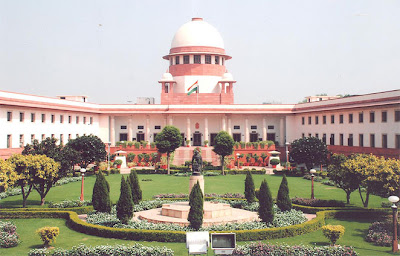
Supreme Court of India
           Recently there was a news item which said that, going by the time taken by our judiciary to disposes of the cases, it would take about 350 years to solve all cases pending in the courts of India. The rate at which new cases are coming to judiciary far exceeds the rate of disposal, and the difference, is only increasingly. Hence we can conclude that, effectively, for a large population there is no judicial remedy available at all. I hope readers realize what a big statement that is. Unfortunately it is not a hyperbole at all. Even normal simple cases take years to complete. There is every chance of the justice being denied, on the basis of money/muscle power. Out of court settlements are the norm in India. People in power or in influential posts, hardly ever get punished. Fighting a case in court itself is extremely costly, stressful, time-consuming and somewhat like a punishment in itself.
            Of all the state instruments that the Britishers brought from England to India, such as the police, the civil services, the railways etc., the judiciary was perhaps the only one, whose fundamental nature was not completely changed to suit the continuance of the colonial rule in India. Although in colonial India, Judiciary could hardly be called impartial or fair, as it openly practiced racial discrimination, (hugely favoring Europeans over native Indians) enforced laws that were against the very principle of national justice, bowed to the Viceroy's wishes in cases of great political significance etc. However the Judiciary, even then, was completely secular, above caste politics and most importantly based on rule of law, and not personal prejudice. This, being very rare in contemporary Indian society, was very much appreciated, and it even created the famous myth of "British fair play". 
           After independence, the government focused on to have a systematic judicial system throughout the country and many new subordinate courts were established in various parts of the country. Also, the judiciary was made completely independent of the government, thanks to the vision of Jawaharlal Nehru. Over these years our Indian Judiciary was given some excellent decisions and has earned the faith and respect of ordinary citizens more than any other institution. However, this is only limited to the higher Judiciary. The lower judiciary is riddled with corruption and nepotism. In fact, as a whole, the standard of the judiciary has been falling continuously.
           So what is the real problem? Many people attribute it to the lack of enough courts/judges as per our huge population. According to them, if we can establish a lot of courts and employ thousands of judges, we would be able to overcome this backlog or at least reduce the normal time duration of the cases. However, that is a myth. There are structural weaknesses in our judicial system. They will not go away just by creating more courts. Let us go over them one by one, along with offering solutions for each of them.

Lack of accountability of Public Servants 
           The most crucial thing that plagues our judicial system is that it is not able to punish Public Servants for not doing their jobs properly. Let me explain it. Suppose a person is intentionally harassed by the bureaucracy, like his pension/salary is not being released, or, on some flimsy reasons, he is not given the required license/documents etc. He then goes to the courts with his petition. All that the courts will do, will be to ensure that the genuine work of the petitioner is done. But most importantly, nothing would be done to the bureaucrat, who should have done this job, without court intervention. There is no fixed accountability of any bureaucrat for any particular job or task. The accountability notionally rests on the whole department, or on the 'Head of Department', who actually never looks personally in each case. Blatantly deliberate acts of delay or denial of services never get punished and are never even considered under the prevention of corruption act. Now consider the consequences – the bureaucracy does not have the fear of the judiciary and hence they openly harass the common citizen for bribery. If the citizen protests, he can go to the courts (which is way more expensive and time-consuming) where his work would be done but the bureaucrat would have nothing to lose. Hence naturally most people prefer to pay a bribe and the rest keep increasing the court case score, without changing anything in the system. It is therefore not a surprise that maximum cases in courts are about matters that are no-brainers and that should ideally have been sorted out by the bureaucracy itself.
            A citizen’s charter (or Grievance Redressal mechanism) which actually treats delay/denial of services under the prevention of corruption act and fixes personal accountability for every task to a public servant, would go a long way in easing the pressure on the judiciary.
 

Sticky Areas
           There are certain types of cases which form an unusually high percentage of the total cases. These are the result of a lack of clear (or deliberately ambiguous) policies and rules. Let us take the example of land disputes, which form the single largest chunk of court cases. The worst thing about land disputes is that no document can claim to be unambiguously final and above any reproach. You can have the same piece of land lawfully registered by multiple parties. In the court, the land registry is given no weightage. And the worst part is that the officer who issued the land registration, without checking whether the land was prior registered or not, goes absolutely scot-free. Land Registration document, for which government charges so much and is considered valid proof in many scenarios, is thus effectively, just another instrument of confusion. Documents are deliberately kept in an inconsistent state and are the breeding grounds of corruption in India. It’s not just our complicated history, but the rules that are to blame for this mess. There is no reason why in India we can’t have digitization of all land records, which would be available all across India, in every department in perfect synchronization. It is not a new idea and we have several successful implementations of it. It would ensure that inconsistent documents can never be generated in the future. It would also result in a drastic decrease in land disputes cases with every passing year. All such area (like land disputes) require the same solutions – making laws simpler and clearer, increasing transparency in government departments, introducing IT solutions (e-governance) and reducing human dependence.

Lack of fear of Courts
           The popular perception in India is that if you have power, you can do absolutely anything in this country. It is a real shock to see so many “contempt of court” cases pending. How is the bureaucracy so relaxed with these cases? It is again a case of lack of fear for the judiciary. The courts only do tough talk, but stop short of actual strict disciplinary actions, even in 'contempt of court' cases. It is less of a case of legal power and more of a case of wrong convention (and sometimes corruption) on the part of Indian Judiciary. There are many cases where it is very apparent that one party is deliberately trying to delay the proceeding as much as possible. Instead of ignoring, the courts must take very strict action and set an example. 
Falling Moral standards
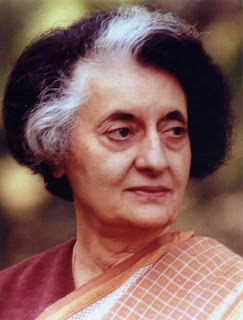
Indira Gandhi
           No one can deny that the moral standard of Indian Judiciary is falling by leaps and bounds. It has a bit of history behind it. The tussle between the Judiciary and Indra Gandhi is very well known. During the emergency, the power and prestige of the Judiciary were greatly damaged. Till then, the selection of the Judges was solely under the executive and it was highly misused by Indra Gandhi, besides several other mechanisms to make the institution more loyal to her. Just like the permanent damage that Indra Gandhi did to constitutional posts like the governor, the president etc., the damage to the Judiciary could never be fully restored, even after valiant efforts of people like law minister Shanti Bhushan. More than laws, the customs, traditions and prevalent ethics matter in any establishment.
           The government too has played its part, by giving extremely lucrative positions to preferred High Court and Supreme Court judges, after their retirements. Even though there are no reservations in the Judiciary, the common custom has been to have that consideration, in the selection of Judges, resulting in a poor selection and falling standards.


Reform of court proceedings
           Today the moral standard has stooped so low that bribes are openly taken in courts to just get the case heard. Courts itself have become arenas of corruption and harassment. How can we expect the citizens to have faith in the judiciary, if even in the courts, we have bribery, nepotism and preference to the rich and the powerful?
           The whole approach has to change. Once a case gets in the court, it should become the court's responsibility to ensure justice, and not the petitioner's job to follow up his case, ensure that it does not get lost in the endless files, bribe babus to get dates quickly etc. IT solutions should be employed to ensure no manual interference. Special officers need to be appointed to look at every case in the backlog and ensure that the cases are closed properly. Not just the judgments, but even the relevant documents of each case must be digitalized. Cases which are no longer relevant must be closed off.
           The role of the lawyers, especially in simple cases, should be diluted. The result of any case should depend on the merits of the case and not on the lawyers involved. Unnecessary technicalities must be straightened out and courts should encourage educated people, in simple cases, to present the case themselves. Currently, cases are dismissed on the basis of mere technicalities. Instead of that, the judges should themselves assist in reformatting the writ (as far as possible) then and there.

Vernacular Languages  
          For most local people, courts are a complete mystery because of their ignorance of English language and illiteracy. Though local languages are allowed in lower courts, in many places, it is generally not the norm. Rulings are generally written in English only. This results in over-reliance and blind faith in lawyers, who may or may not have the best interests of their clients in their minds. Lower courts must function in local languages only. For judges it should be absolutely necessary that they know English, Hindi, the local language, as well as local dialects prevalent. All judgments should be in all three languages. Judges should not be burdened with this. Special staff should be kept just for this translation.
           The petitioner should be able to comprehend all that goes on in the courts, the reasons and logic for a particular court decision and thereafter he should make an honest judgment whether to go a higher court or not. Lawyers typically always encourage the losing party to go to a higher court, for their own personal gains. Moreover, the penalty must be increased if a person goes to a higher court unnecessarily on flimsy grounds.

Lack of check and balances
           Because of the notion of the Independence of Judiciary, removal or even trial of any Judge is extremely difficult. Permission is required from the Chief Justice of India to even start an investigation against a Judge. While protecting judges against trivial and personally motivated false cases, is very important; the special privileges and lack of accountability of Judges, becomes counterproductive when bad eggs are introduced in the system. They further spread their corruption unabated in the system, endangering the entire system.
    The situation demands urgent remedies. An institution, completely independent of the Government and the Judiciary (like LokPal or a separate institution altogether) should be empowered to decide whether a case against a Judge merits investigation or not. A feeling of accountability needs to be created among Judges and it cannot be left just to the corrective measures within the Judicial System itself.

Friday, November 25, 2011

The Kashmir Saga

The current map of Jammu and Kashmir
The Kashmir issue is without doubt, the most profound and chronic problem in India, ever since independence. It has been at the center of umpteen number of articles, TV debates, diplomatic talks, UN speeches as well as wars between India and Pakistan. When it comes to Kashmir, a majority of  Indians become too emotional and patriotic, and they fail to analyze the problem rationally. Most Indians have no ideas as to what is the real conflict, how was it created, what has aggravated it so much, and what is the current ground realities in the Kashmir Valley. In this blog, I have tried to touch upon each of these points.


Contrary to popular perception, Kashmir is a problem that successive Indian Governments are solely responsible for creating and nurturing. Of course the role of Pakistan and certain extremist elements in Kashmir cannot be denied; but primarily, the lack of foresight and faulty policies of the Indian state are responsible for the "monster" that we have created.

The problem starts with the stupid idea of partition. Given the social fabric of the Indian society, with a mix of different communities in almost every village, the very idea of "Partition", based on religion, was nothing better than (using Nehru's words) "A Fantastic Nonsense". There could never be a rational way in which, a partition line, could have be drawn between the two countries, that would be acceptable to both. It was finally drawn in the most ad-hoc and whimsical manner, by the departing Britishers. Yet, left with no better alternative, both parties accepted the British line of divide and there has been no dispute about it ever since. However the point to note is that, if at that time, the final line was left to talks and dialogues or UN resolutions (like Kashmir), India and Pakistan would still have been fighting over it, as certain things can never be resolved by any amount of dialogue.

Before Independence J&K was a princely state, with a Hindu king and mostly Muslim population. Other than its  unique location, between India and Pakistan, there was nothing very unique about J&K. Just like other princely states, the J&K was not like a nation. There was no real unity (cultural or otherwise) or national feeling among its people and really nothing to distinguish it from rest of the country. Actually, J&K was a place where the Muslim League had almost no influence. J&K had been the most peaceful during the Hindu-Muslim riots of 1946. There were hardly any Islamic extremist elements in Kashmir at that time.


Sardar Vallabhbhai Patel
The Britishers had instilled hope in the various Crown princes, that after the British withdrawal, they could finally become independent. Many idiots, including Hari Singh of J&K, actually fell for it. The British tried, whole-heartedly, to support the independence claim of states like Travancore (which had much better prospect of surviving independently than J&K) and Hyderabad. But frank diplomacy backed with the option, and use of military force, by Vallabhbhai Patel brought all such states within India. None of the states were given any special rights. Later, due to the linguistic division of Indian states, their very identity was lost in history.

Why is then the J&K different from other cases, like that of Hyderabad? Both Pakistan and England had fully supported Hyderabad, just like J&K. In both cases Indian army had intervened. In both cases, the public opinion, at that time, in the state were mostly the same. Yet, 60 years later, it is almost impossible to even think about an independent Hyderabad, whereas there is a strong ongoing demand for the independence of Kashmir.

I do not claim J&K to be a part of India just because Hari Singh signed the Instrument of Accession (that is for stupid international talks), but because Kashmiri society was the best example of Hindu-Muslim unity and the best rejection of the very idea of Pakistan. But every since independence the Indian government has committed one blunder after another in Kashmir leading to such a sorry state of affairs today.


Nehru and Sheikh Abdullah
Nehru had a special attachment towards Kashmir Valley and a very special fondness towards Sheikh Abdulla of the National Conference. Failing to leave the matter to the more pragmatic Patel, was the first major mistake. It was India who pressured Hari Singh to release Sheikh Abdulla from prison, making him the most important political person in J&K. Yet surprisingly, Nehru could not convince Sheikh to integrate J&K with India. India should have been much more proactive in J&K before the Pakistani invasion, since India had upper hand, as Sheikh, the most popular leader in Kashmir, was definitely anti-Pakistan, though not completely pro-Indian. However India did not act, whereas Pakistan stepped on cross-border infiltration as well as created trouble in the Poonch district.

In 1948, when Pakistan  attacked J&K (disguised as tribal invasion), India did not respond until the accession papers were signed by Hari Singh, thereby giving a big decisive initial advantage to the Pakistani army. The military strength of the two countries being almost equal, at that time, and the winter of 1947, meant a halt in military operations. It was now that India made the biggest blunder in its history, a mistake which was to cost India very dearly, even after 60 years. Instead of forcing the integration of J&K into India, Nehru gave the complete power to Sheikh Abdulla's and left the question of accession still open, even though the Indian Army was welcomed in Kashmir as liberators. Instead of Sheikh Abdulla being the "Chief Minister", he became the "Prime Minister" of J&K !!

Now, under the influence of Mountbatein, Nehru made another big mistake. Instead of waiting for the end of winter and going for a final military solution, India decided to take this matter to the UN. At the UN, India was almost completely alienated on this issue, with the British backstabbing India and supporting Pakistan. Indian 'Non-Allied Movement' (though very good) did not help matters either. The grand illusion of Nehru, that the UN was a just and rational body, and not driven by short term interests of few nations, came crashing down upon him. However the damage was done. The Pakistanis had strengthened their position in the winters and though fighting continued throughout the summer of 1948, (with India winning back Kargil and Drass) full military solution could not be reached before another ceasefire.

But all was not well even in the Indian part of Kashmir. In 1950, the Indian constitution came into force and recognized J&K as part of India but it was given special privileges in the form of Article 370. This was perhaps the biggest mistake made by the Indian Government. Hence, from this point onwards, when all other princely states were fast loosing their identity, J&K was gaining a special identity and Sheikh Abdullah was becoming ever more ambitious.


Dr. Shyama Prasad Mukerjee
A distinction must be made between the Kashmir Valley and the "Jammu and the Ladakh" region of J&K. Jammu being a predominantly Hindu majoriy region and Ladakh being a Buddhist region, always wanted complete accession to India. Here Sheikh Abdulla was never that popular and in 1952-53, these regions rose in revolt against the Sheikh's government encouraged by Dr. Shyama Prasad Mukerjee, of the BJP. He subsequently died in the Jammu Jail for the cause, creating huge unrest in the region. It was a clear case of gross mismanagement by the central government and the lack of effective Home Minister like Patel was clearly evident.

But the worst effect of the agitation was that Sheikh Abdulla, encouraged by the American embassy, now openly sought for independence of Kashmir. He was put behind bars by Nehru without any charge, and Bakshi Gulam Mohammad was made the CM. Such neck-jerk reaction and high-handedness was bound to get resentment from the general public in Kashmir Valley. Moreover Bakshi turned out to be thoroughly corrupt, making matters worse. Hence Article 370, coupled with the mad events of 1950s, made sure that J&K was never fully assimilated into India and always remained a thorn in the flesh.

Right from the beginning there has never been any systematic Indian policy towards Kashmir which has made matters much worse. Sheikh Abdullah was release twice, in 1958 and in 1964, only to be locked up again after a few months. During his last days Nehru desperately tried to diplomatically solve, the Kashmir issue, once for all, but his death laid to rest all such efforts for ever. Successive elections were held in Kashmir, keeping the most influential leader in jail. Moreover, elections of 1967 in J&K, were openly rigged by Indra Gandhi, leading to deep resentment. Successive corrupt governments and the aloofness of the center made, for the first time, pro-Pakistani elements a majority in the state. India was thus slowly beginning to losing ground through its own mistakes.

Lack of foresight of Nehru and the ill effects of Article 370 became more pronounced with every passing year. After partition lakhs of Sikhs went to nearby states to earn their livelihood and due to their hardworking nature, they started having a significant influence in those areas, besides boosting their economies. However Article 370 insured that there was absolutely no investment in Kashmir and no intermingling between the J&K and the rest of India. None of the good central schemes, reached Kashmir. Laws made in Delhi no longer mattered in Kashmir, hence the national feeling could never develop there. Compare that with other places like Tamil Nadu, Assam etc, where, though there were strong regional sentiments at one time, nationalism kept gaining ground over the years. Also, for the rest of India, J&K became a very emotional issue directly related to the national pride. Unfortunately, instead of loving the Kashmiri culture and people, the Kashmiri land became the most prominent issue.

India won a major victory in the 1971 war with Pakistan. However right after that it lost a major diplomatic battle with Pakistan. Instead of solving the Kashmir issue once for all, a weak Shimla Agreement was signed where Pakistan just made an informal promise (which was never kept) of converting the LOC into an International border.


Mirwaiz Umar Farooq
After the scathing loss of 1971, Pakistan decided to pay back India in the same way, and J&K was the ideal battleground for Pakistan. Extremism was extensively encouraged in the whole of Pakistan and especially in POK. Cross border infiltration and terrorism was gaining ground. Seikh Abdulla, meanwhile had reached a truce with the Congress and he was back as the Chief Minster in J&K. However his popularity, even in the valley had decreased considerable. He was no longer the sole voice of the valley.

A lot of local (Islamic as well as Secular but Pro-Independence) organizations came into existence. Prominent among them were - Jammu Kashmir Liberation Front (JKLF), Muslim United Front (MUF), Awami Action Committee etc.  However the more serious trouble was the formation of militant organization like - Jaish-e-Mohammed, Ḥizbal-Mujāhidīn, Harkat-ul-Mujahideen etc. These militant organizations got a lot of help from the Pakistani Intelligence agency, ISI, and Pakistan based state terrorist organizations like Lashkar-e-Taiba. The hanging of Mohammad Maqbool Bhat  (of JKFL) in 1984, (although necessary) further provoked militancy. The  government of the day also played its part in the mess by constantly rigging every elections (like the elections of 1987) to ensure that extremists could never get elected in the J&K assembly. This led to the rise of an armed insurgency movement composed, in part, of those who unfairly lost elections.


The 1990's (1989 onwards) was the darkest period in J&K. Ever since the fall of USSR, the 'Mujahideen' of Afghanistan, were diverted to Kashmir by Pakistan. Cross-border insurgency came to an all time high. Continuous anti-India protests provoked lath-charge and even firing, which in turn, added more fuel to the fire. The All Parties Hurriyat Conference was formed as a grand alliance of various anti-India parties in Kashmir and they remain till date the strongest group, outside the mainstream.
Refugee tent colonies as a result of Kashmiri Pandits
exodus from the valley
Eventually the army had to be called, to douse the situation. However in a rogue incident many unarmed protesters too got killed. This resulted in a wave of revenge killings, especially against the Kashmiri Pandits. Most of the estimated 162,500 Hindus in the Valley, including the entire Kashmiri Pandit community, fled the Valley in March 1990. This was one of the worst human tragedies of independent India. The scale of ethnic cleansing in the valley was very much like that of the Jews in Hitler's Germany. The demography and the culture of J&K was changed for ever, right under the nose of the Indian State. The worst thing was that instead of a political struggle, it became a 'Jihad' to create an Islamic state in Kashmir. The very idea of Secular India now was under threat, ironically in the same place, which had once been, the model of Hindu-Muslim unity. Although foreign hand behind the 1990s turbulence in the valley cannot be denied, the fact remains, that it had a lot of popular support, and the Indian policy for the last so many years, was the major reason behind it.

Over the next decade the army brought relative peace in the valley. The border was sealed off and a lot of militants were encountered. Thousand of martyrs laid down their lives in the service of the nation. The army heavily contributed towards developmental activities in J&K, and also relief and rescue activities, in case of natural calamities. However, even after doing such a great job, with great discipline and hard work, the army failed to win over the hearts of the common Kashmiris. The feeling of alienation, increased rather than decreased. There are precise reasons for the same. The most important being ASFPA.


Along with the army presence, came the notorious ASFPA act (July 1990) in J&K. ASFPA is a draconian act which gives complete immunity to the armed force from any action, including the right to shoot on sight. Such an act was very necessary in the 1990s for the army to function smoothly. Otherwise, it was almost certain, that India would not have been able to hold on to Kashmir any longer. However, army presence is never compatible with civil administration. The major problem being that army personals can never be tried in civil courts and for any human right violations, alleged or otherwise, the general public has no avenue for redressal of his grievances. Even though there are many parts in our country, where human right violations and  atrocities committed by the police are much greater, the very presence of legal system, howsoever ineffective and slow, acts as a effective counterbalance. Acts like ASFPA, create a much greater feeling of alienation in the general public, and even normal incidents get blown out of proportion. There are loose cannons everywhere, even in army. There have been cases where, for promotion or rewards, army personal have victimized innocent citizens. At other times, some genuine human mistakes were also made. The worst part been that, even if action was taken against them, it happened in army courts, away from the public eye. Hence justice was never visible on the ground.


Since the 1990's the story till date, has been pretty much the same. There are approximately half a million Indian security forces deployed in the Kashmir Valley since the nineties. Continued violence has taken the lives of tens of thousands of civilians. The fact remains that without the army, the India state cannot exist in Kashmir, even though the insurgency has largely been controlled. A decade of ASFPA has created a very strong negative feeling on both sides. In the army, there is a distinct dislike towards the native population as they have seen scores of their fellowmen been killed by the militants, some of them Kashmiris, and others claiming to be fighting for the Kashmiris. In their view, Kashmiri are ungrateful and unworthy of their great sacrifices. On the other hand, the general Kashmiri (in the valley mostly) views the army with great fear and treat them as foreign occupying forces, having absolute power. They deeply resent their suppression of civil rights under ASFPA, the fact that they have to carry IDs all the time, the various army checkpoints spread everywhere, the high-handedness with which the army treats them, and the little hope that they have, of things ever becoming better. The fact that very few Kashmiris are actually part of the army doesn't help matters either. Adding to that, is the strong propaganda of the Hurriat Conference, and the rabble rousing of the opportunist mainstream politicians. 


Syed Ali Shah Geelani of the Hurriyat Conference
In recent years Pakistan has been too preoccupied with its eastern border, and hence cross-border terrorism is at all time low. The total no of insurgents in the valley are estimated to be less than 500 now. Violence has come down significantly. Things look better from the outside, but they are not. The danger is greater now since it emanates from within, rather than from outside. Instead of bullets, the Kashmiris have taken to mass protests, strikes and stone pelting. 2010 has been one of the worst years in Kashmir. Protesting against the alleged fake killings by the army, lakhs of people joined the protest and more than a hundred died in the clashes that followed, over the next several months. India had to use its full force to subdue the protests. Such mass protests have seriously weakened the moral position of the Indian state in the Kashmir valley. To a nationalist like myself, the situation's uncanny resemblance with the British rule in India is deeply troubling and worrisome. Passive resistance by common man is far more dangerous than any armed rebellion. A complete and comprehensive strategy for J&K is the dire need of the hour.

Kashmir has not been the only troubled region in India, clamoring for independence. At one time militancy in Punjab almost rivaled that of Kashmir, but today it is almost completely over. The reason for the above, was a lack of external support, lost of popular mass support and the fact that the main force fighting militancy, were the police, compromising of Sikhs only. These are the exact lessons that should be applied in Kashmir also. A partial removal of ASFPA, from certain districts is a step in the right direction. Civil laws must be strengthened to give more powers to the police. The J&K police must be heavily armed and equipped with latest gadgets. J&K police should recruit more and more unemployed people in the state, and should be kept at the forefront against any insurgent attack. Casualties of local Kashmiris at the hand of terrorists, would erode their popular support base. At the same time more Kashmirs must be inducted into the Paramilitary forces and sent to different parts of the country like the Northeast. Army presence must be made less and less visible and should only be concentrated on the border areas to make sure that there is absolutely no help from across the border. After a few years of peace, Article 370 must be slowly diluted, with a single point agenda of attracting investment (especially foreign) in the state, and not changing the demographic profile of the state. Sustained economic progress is the surest way of combating terrorism in the state. After that, there must be a sustained effort to resettle the Kashmiri Pandits back in the state in a natural unforced way, by giving them property, industry rights and economic help etc. Slowly but surely the complete Article 370 must be scrapped, facilitating J&K's complete integration into the country. A trifurcation of the state with the removal of Article 370 from Jammu and Ladakh region, is also an idea worth considering.

How mush of the above is actually possible and how much would just remain wishful thinking is anyone's guess. One thing is certain, that there is no quick solution for the problem and it is going to take a very long time. The government should devote its full energy and effort in trying to win back the popular support and there should be a detailed plan for the same. However sooner or later, people's wishes will have to be respected. Only 'Soft power' and not 'gun power' can deliver the final victory. If, however (in the worst case) none of the efforts materialize, and people in the Kashmir Valley remain defiant as ever, then it is in the interest of both Kashmir and the rest of India, that there should be a referendum and India should respect the result. As it is said, it you truly love a person, you need not hold her tight. Let her leave, and she would come back to you. 

Search This Blog

Followers